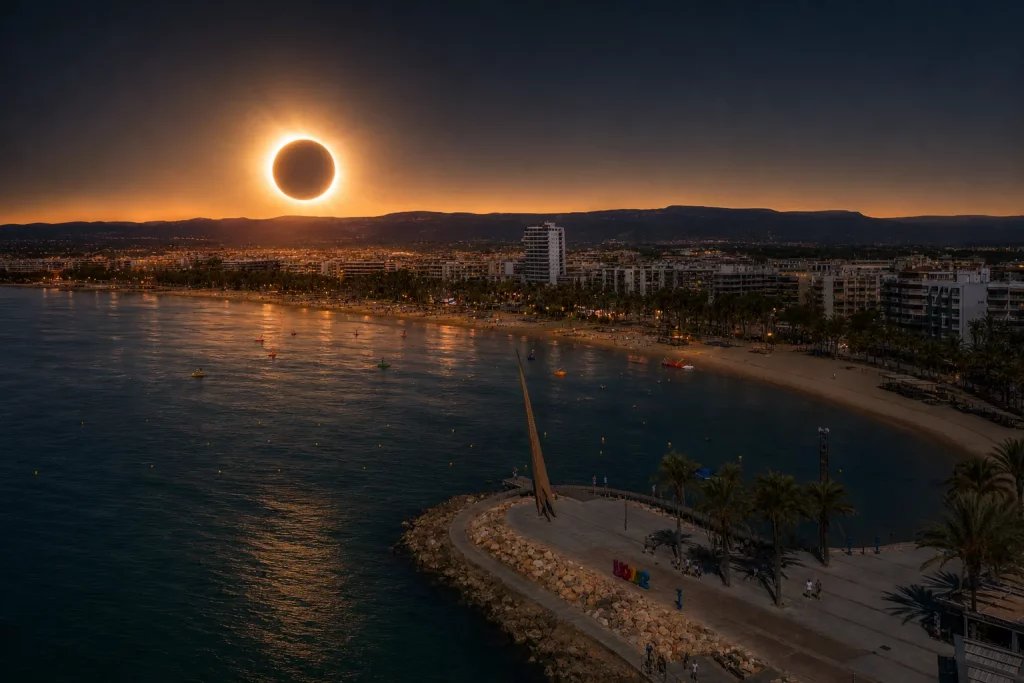
On Wednesday 12 August 2026, at around 8.30 pm, day will briefly turn into night across the Costa Daurada and the Terres de l’Ebre. The Moon will completely cover the Sun for approximately one minute, creating a sudden darkness shortly before sunset.
This will not be a partial eclipse or simply an astronomical curiosity. It will be a total solar eclipse, the first visible from the Iberian Peninsula in more than a century and a phenomenon that will not occur again in Spain until 2053. Tarragona province will lie within the path of totality, with some of the longest periods of darkness in Catalonia occurring in the Terres de l’Ebre.
Salou is preparing its beaches to welcome thousands of spectators, Tarragona has designated several large observation areas, Deltebre is organising three viewing points in the Ebro Delta, and Prades will host a four-day astronomy festival.
There will be no need to travel to Iceland or chase the Moon’s shadow across the world: one of the greatest natural spectacles of the century will pass directly over Southern Catalonia.
Key information about the total solar eclipse of 12 August 2026
- Date: Wednesday 12 August 2026
- Start of the partial phase: around 7.35 pm
- Totality: between 8.29 pm and 8.31 pm
- Duration of totality: from around 50 seconds to more than 1 minute 30 seconds, depending on the location
- Direction: west-north-western horizon
- Height of the Sun: only four to five degrees above the horizon
- Eye protection: compulsory throughout the partial phases
- Sunset: approximately between 8.58 pm and 9 pm
- Local time: Central European Summer Time, CEST
Times may vary by a few seconds depending on the exact observation point. Official calculations are based on the coordinates of each municipality and the altitude of the terrain.
Why will this eclipse be so special?
A total solar eclipse occurs when the Moon passes directly between the Earth and the Sun, completely covering the solar disc. For a few extraordinary moments, the brightest part of the Sun disappears, revealing the solar corona: its outer atmosphere, normally hidden by the intensity of sunlight.
The sky will not become completely black like the middle of the night. Instead, it will take on the appearance of an intense twilight. The horizon may glow in every direction, the brightest planets and stars may become visible, the temperature will drop and the landscape will change in a matter of seconds.
The difference between a 99% eclipse and a total eclipse is not simply the final 1%: it is an entirely different experience. Until the Sun is completely covered, the remaining sunlight is still powerful enough to dominate the sky. When totality arrives, everything changes at once.
In Southern Catalonia, the 2026 eclipse will take place when the Sun is already extremely low. This will create an especially photogenic scene, but it will also make observation more challenging. A tree, hill, building or grandstand in the wrong direction could completely block the most eagerly awaited minute.
Advice for watching the eclipse on the Costa Daurada
A sea view does not necessarily guarantee a clear view of the eclipse. The most important factor is an unobstructed north-western horizon
In Southern Catalonia, the Sun will be positioned towards the west-north-west, at an approximate azimuth of 286 degrees and only four or five degrees above the horizon. You therefore need to find an open location facing the sunset and check that there are no low obstacles in that direction.
The best location will not necessarily be the highest viewpoint, the prettiest cove or the most remote place. Four specific factors will be essential:
- A completely unobstructed north-western horizon.
- Safe access and enough space for visitors.
- The possibility of arriving several hours in advance.
- An organised departure after the eclipse.
For this reason, the safest option is to prioritise the official observation sites, which have been selected after considering visibility, access, capacity and available services.
Where to see the 2026 total solar eclipse in Southern Catalonia
Salou, for an eclipse beside the Mediterranean; Tarragona, with six major observation sites; the Terres de l’Ebre, with longer totality; the Ebro Delta, with enormous open horizons; and the Prades Mountains, with the most complete astronomical experience
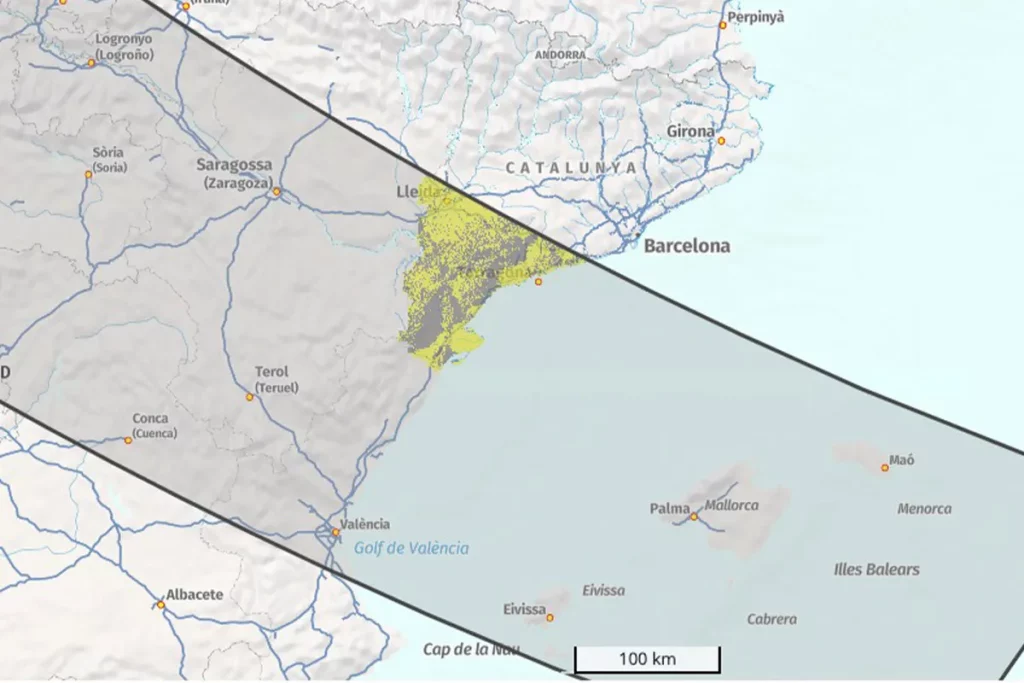
SALOU | A total eclipse from the beaches of the Costa Daurada’s main resort
Salou will be one of the most accessible and lively destinations from which to experience the eclipse. The partial phase will begin at approximately 7.35 pm and totality will start at around 8.29.26 pm. Maximum eclipse will occur at approximately 8.30 pm, with the Sun completely hidden for around 67 seconds.
The local council has chosen Salou’s beaches as the main setting for the observation and is preparing a programme of family activities, entertainment, educational areas and meetings with astronomy experts. The event will form part of the town’s Nits Daurades summer celebrations.
Salou’s greatest advantage is its capacity to accommodate visitors. It offers an extensive selection of hotels, public transport, restaurants, tourist services and several kilometres of beaches. It is also expected to be one of the liveliest places in Southern Catalonia during the eclipse.
The local council will distribute approximately 40,000 certified eclipse glasses among residents and visitors. Because the event coincides with the Nits Daurades festival, spectators are advised to arrive early, use public transport and avoid entering the town centre by car at the last minute.
- Best for: families, visitors already staying in Salou and travellers looking for a comfortable experience with plenty of atmosphere.
- Important: arrive several hours in advance and follow official advice about which sections of beach offer the clearest view.
TARRAGONA | 6 major observation areas across the city
In Tarragona, totality will begin at around 8.29 pm and last approximately one minute. For 61 seconds, the Moon will completely cover the Sun and the city will fall under the lunar shadow.
Tarragona City Council has designated six observation areas to distribute spectators and reduce unnecessary movement across the city:
- Bonavista, with an estimated capacity of 15,000 people.
- Anella Mediterrània, with capacity for 10,000 people.
- Parc del Francolí, for approximately 2,000 people.
- Sescelades University Campus car park, for around 7,000 people.
- Port Marina Tarraco, with an estimated capacity of 20,000 people.
- Sant Pere i Sant Pau football ground, for approximately 1,500 people.
This is an important point: the main official observation areas do not necessarily coincide with Tarragona’s best-known tourist viewpoints. The Balcó del Mediterrani and the city’s beaches may provide beautiful scenery, but the designated sites have been selected according to the real position of the Sun, visitor capacity, accessibility and safety.
Tarragona has also developed an educational programme featuring planetariums, workshops, video mapping and activities connecting astronomy with the history of Roman Tàrraco.
From 15 July, the council is distributing approximately 23,000 free eclipse glasses through municipal offices, community centres, pharmacies, primary healthcare centres and tourist information offices, while stocks last.
- Best for: travellers who want to combine the eclipse with Roman heritage, Mediterranean food and cultural activities.
- Important: choose one of the official observation areas and do not attempt to improvise from the historic centre shortly before totality.
TERRES DE L’EBRE | Longer totality and wide-open landscapes
The Terres de l’Ebre will be one of Catalonia’s leading eclipse destinations. Its position within the path of totality means that several towns will experience longer periods of darkness than much of the Costa Daurada and the Tarragona area.
In Deltebre, totality will last approximately one and a half minutes. Amposta will experience around 1 minute 33 seconds, Camarles approximately 1 minute 31 seconds, and Alcanar around 1 minute 37 seconds, one of the longest durations among Catalonia’s official observation points.
The Terres de l’Ebre Tourist Board also highlights Roquetes, home to the historic Ebro Observatory, as one of the Catalan locations with the longest totality. Amposta, Tortosa, l’Aldea, Santa Bàrbara, Gandesa and Alcanar are also preparing to become strategic observation centres.
THE EBRE DELTA
Deltebre has announced three specific sites for watching the eclipse:
- Lo Passador bridge.
- Finca de Bombita.
- Riumar Beach.
Talks, astronomical observations and public-awareness activities will also take place during the weeks leading up to the eclipse.
The Ebro Delta offers a setting that is difficult to match: rice fields, lagoons, canals, dunes and an enormous horizon. However, it is also a fragile natural environment. Visitors must not park outside authorised areas, enter private farmland, block rural tracks or gather in protected locations without appropriate services.
The Punta del Fangar and the Trabucador sandbar are two of the Delta’s most iconic landscapes, but photogenic places should not be confused with sites prepared to receive thousands of people. Visitors are strongly advised to use the official observation areas.
Official observation points in the Terres de l’Ebre
The Catalan Government has selected several locations, including:
- Alcanar: bullring.
- Amposta: l’Oriola industrial estate.
- Camarles: Pla de Camarles.
- L’Aldea: Can Gironès.
- Gandesa: La Plana industrial estate.
- L’Ametlla de Mar: municipal football ground.
- Móra la Nova: Carrer Tortosa.
- Santa Bàrbara: sports area beside the road to La Galera.
Alcanar is preparing an event combining observation, music, gastronomy and introductory activities. L’Ampolla will also offer a special programme in collaboration with the Osona Astronomical Association, while Ulldecona and Tortosa will connect astronomy, heritage and gastronomy between 11 and 13 August.
- Best for: travellers seeking longer totality, large open landscapes and a nature-based escape.
- Important: do not improvise in agricultural areas, remote beaches or protected natural spaces.
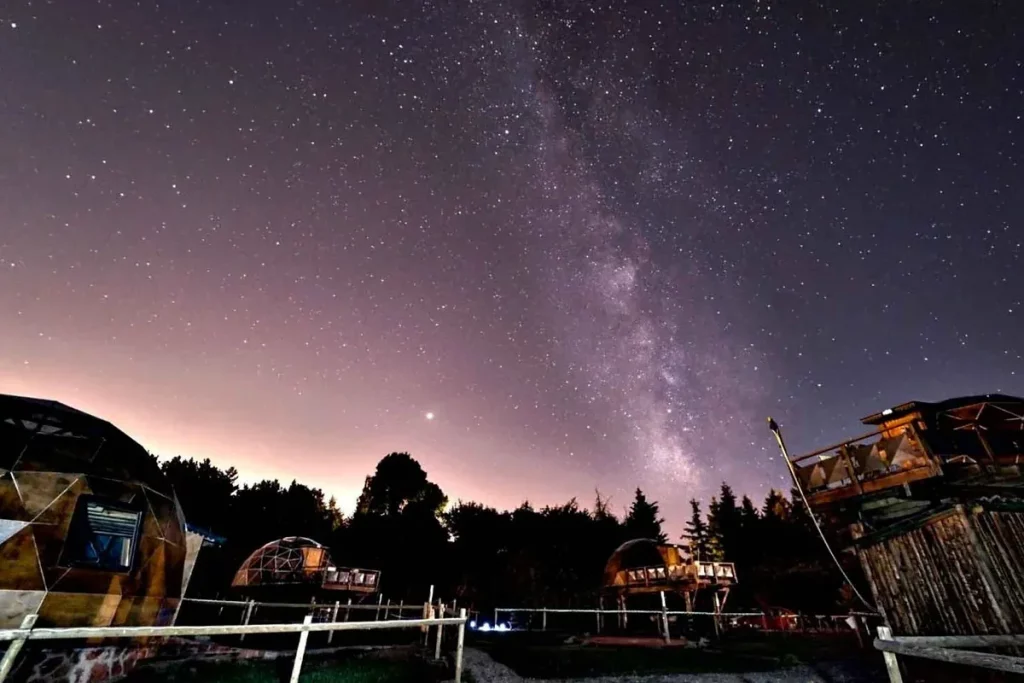
MUNTANYES DE PRADES | La gran experiència astronòmica
PRADES MOUNTAINS | The complete astronomical experience
Prades will be one of the major media and astronomy centres during the eclipse. Its established astrotourism tradition, internationally recognised dark skies and the presence of the Prades Mountains Astronomical Park have made the village one of the most sought-after destinations.
The total phase will begin at approximately 8.29.16 pm, reach its maximum at around 8.29.41 pm and end at approximately 8.30.05 pm. Totality will last about 49 seconds, with the Sun around five degrees above the horizon.
These figures challenge a common assumption: Prades will not experience the longest totality in Tarragona province. Its main attraction is something different: an organised experience, guidance from specialists and the opportunity to continue the evening by watching the Perseid meteor shower beneath a high-quality night sky.
From 10 to 13 August, Prades will host the Eclipse Festival 2026, featuring four days of music, talks, telescopes, planetarium sessions, children’s workshops, astronomy, gastronomy and guided observations in Catalan, Spanish and English.
The programme includes activities about the Sun, astrobiology, water rockets, mythology, concerts and a later observation of the Perseids, traditionally known in Catalonia as the Tears of Saint Lawrence.
Accommodation providers such as Xalet de Prades, designed for enjoying the night sky throughout the year, are preparing special experiences for their guests. During the eclipse, they will provide certified glasses and connect guests with experts from the Astronomical Park, helping them understand the phenomenon and observe it safely.
- Best for: astronomy enthusiasts, families looking for a guided experience and international visitors planning to spend several days exploring the area.
- Important: accommodation capacity is limited and mountain roads may become heavily congested.
What will happen during the eclipse?
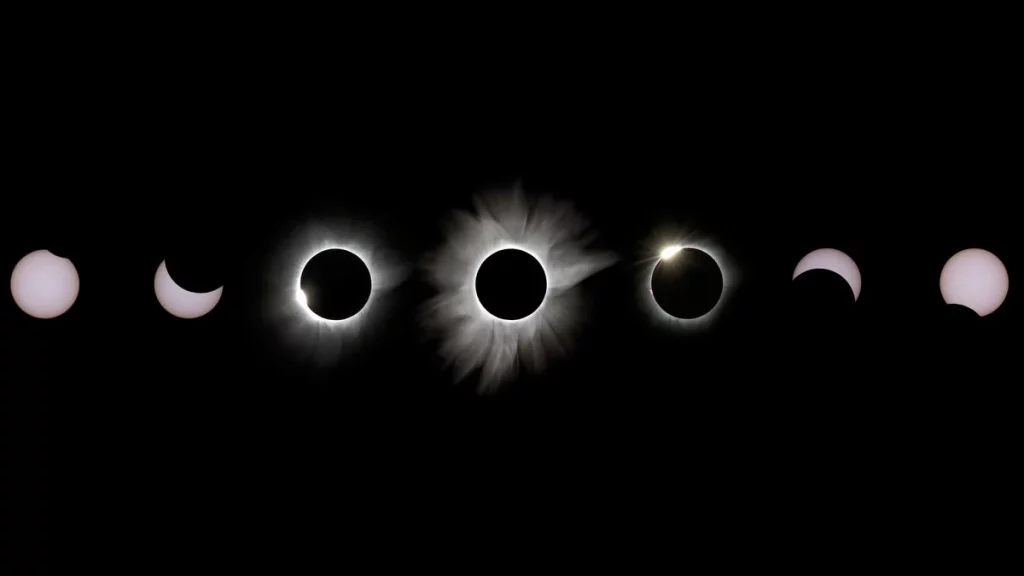
7.35 pm: the partial phase begins
The Moon will slowly begin to cover the Sun. At first, the change will be difficult to detect without eclipse glasses. Over the following hour, the visible part of the Sun will gradually become an increasingly narrow crescent.
8.15 pm: the light will begin to look unusual
When only a small part of the Sun remains visible, daylight will lose its intensity and take on an unfamiliar tone. Shadows will become sharper and the temperature may begin to fall.
8.29–8.31 pm: totality arrives
The final line of sunlight will disappear and the solar corona will surround the black silhouette of the Moon. The sky will darken, the horizon will retain the colours of sunset and some bright planets and stars may become visible.
Depending on the location, this moment will last from less than one minute to slightly more than one and a half minutes.
End of totality: the light returns
As soon as the first bright point of the Sun reappears, eclipse glasses must be put back on immediately. The return of daylight will be just as sudden and surprising as its disappearance.
How to watch the eclipse safely
Looking directly at the Sun without appropriate protection can cause severe, permanent and painless damage to the eyes. Ordinary sunglasses are not safe.
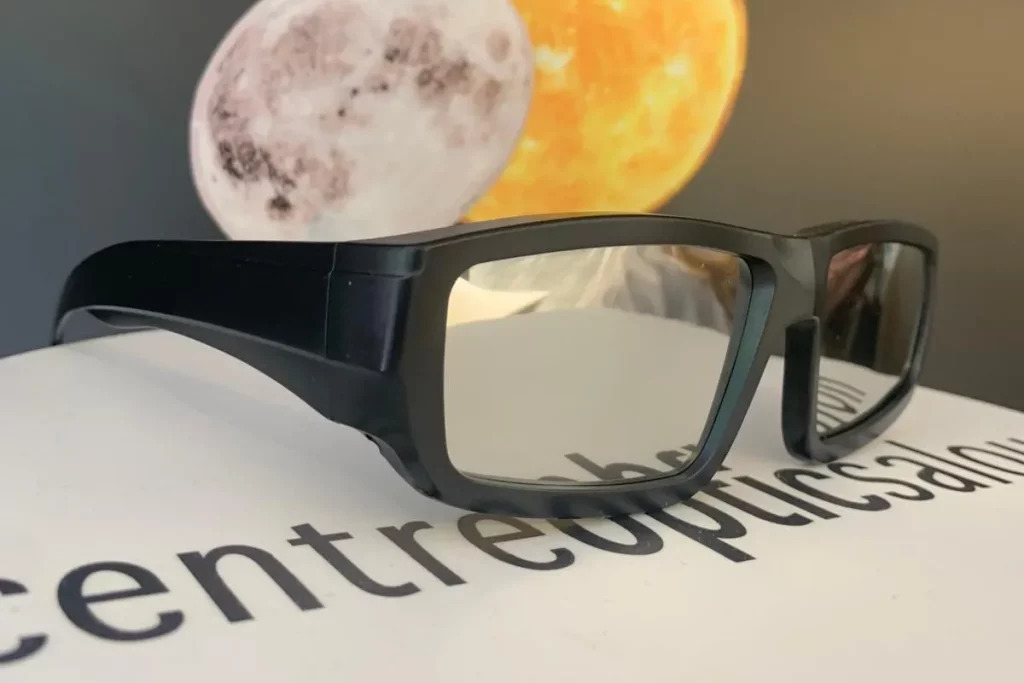
Only eclipse glasses certified under the ISO 12312-2 safety standard should be used. Before wearing them, check that they are not scratched, punctured, bent or damaged.
For complete safety, buy eclipse glasses from a specialist retailer offering certified, reliable and high-quality products. In Salou, they are available from Centre Òptic Salou, located at 15 Via Augusta, where staff can also advise visitors on the correct protection for observing the eclipse without endangering their eyesight.
 The following are not safe: X-ray films, smoked glass, CDs or DVDs, improvised photographic filters or looking at the Sun through a mobile phone screen. Binoculars, telescopes and cameras must never be used without a suitable solar filter fitted to the front of the lens.
These methods do not block solar radiation correctly and may cause retinal burns, blurred vision, dark spots and, in the most serious cases, permanent loss of sight.
Eclipse glasses do not provide protection when looking through binoculars or a telescope. These instruments concentrate sunlight and require specialist filters fitted in front of the objective lens.
The eclipse may only be viewed without glasses during complete totality. As soon as the first point of direct sunlight reappears, eye protection must be used again immediately.
Practical advice for the most important minute
- Arrive several hours early: do not plan to arrive at 8 pm. Roads and access points around Prades, the Ebro Delta, Salou and Tarragona’s main observation areas may become congested much earlier.
- Check visibility in advance: visit your chosen location at around 8.30 pm on a previous day and check the position of the Sun. This is the easiest way to identify buildings, trees or mountains that could block the eclipse.
- Bring water, food and sun protection: the partial phase will begin during a hot August afternoon. You will need water, shade, a hat and sun cream before the eclipse reaches totality.
- Download maps and practical information: mobile networks may become overloaded because of the large number of spectators. Save screenshots, offline directions and the position of your parking area.
- Do not leave immediately after totality: the Catalan authorities warn that the most serious traffic congestion usually occurs just after the total phase. Staying for dinner, attending local activities or waiting for the Perseid meteor shower may be a far better option than spending several hours in a car.
- Forget about filming for one minute: photographing an eclipse requires preparation, filters and advance testing. Without the correct equipment, put your phone away during totality. Thousands of photographers will capture excellent images; no one will be able to recreate how those seconds felt to you.
A double astronomical event: the eclipse and the Perseids
The eclipse will coincide with the peak period of the Perseid meteor shower. As solar eclipses always occur during a new moon, the night will be particularly dark and favourable for continuing to watch the sky after sunset.
Prades and other low-light-pollution areas will host night-time activities, but visitors can also extend their stay in the Priorat, Terra Alta or the Terres de l’Ebre for an astronomical experience that will be extremely difficult to repeat.
FAQS about the 2026 total solar eclipse
Yes. Tarragona, Salou, Reus, much of the Costa Daurada, the Prades Mountains and the Terres de l’Ebre are all located within the path of totality. For several seconds, the Moon will completely cover the Sun.
The duration will depend on the municipality. In Prades, totality will last around 49 seconds; in Tarragona, approximately 61 seconds; and in Salou, around 67 seconds.
It will last longer in the Terres de l’Ebre. Deltebre will experience approximately one and a half minutes, while Amposta, Camarles and Alcanar will exceed one minute and thirty seconds.
The partial phase will begin at approximately 7.35 pm. Totality will occur between 8.29 pm and 8.31 pm, depending on the location, and sunset will take place between approximately 8.58 pm and 9 pm.
All times are local summer time in Spain, CEST.
The Sun will be towards the west-north-west, at an approximate azimuth of 286 degrees. As it will be only four or five degrees above the horizon, it is essential to choose a location with no obstacles in that direction.
During totality, daylight will decrease suddenly and the landscape will resemble an intense twilight. It will not be completely dark like midnight, but the change will be dramatic. The temperature will fall, normal shadows will disappear and some bright planets and stars may become visible.
Only during the brief period of complete totality. Certified eclipse glasses meeting the ISO 12312-2 standard must be worn throughout all partial phases.
As soon as the first point of sunlight reappears, eye protection must be used again immediately.
No. Regular sunglasses do not block enough solar radiation, regardless of how dark they are. Smoked glass, X-ray films, CDs, DVDs and homemade filters are also unsafe.
Yes, provided they wear certified glasses that fit correctly and remain under adult supervision. Children must understand that they cannot remove the glasses or look directly at the Sun during the partial phases.
There is no single perfect location.
Salou will stand out for its beaches, accommodation, services and atmosphere. Tarragona will offer six large official observation zones. The Terres de l’Ebre will enjoy longer totality and wide-open landscapes. Prades will provide the most complete guided astronomical experience.
The best choice will depend on weather conditions, transport arrangements and the type of experience you are looking for.
12 August 2026 will not be an ordinary summer evening. In Salou, Tarragona, Prades and the Terres de l’Ebre, thousands of people will look towards the horizon at the same moment as the Moon extinguishes the Sun.
The phenomenon will be brief, but it will have the power to transform a holiday, an evening on the beach or a rural escape into a memory that lasts a lifetime.
The essential plan is simple: book early, choose an official observation point, check the north-western horizon, bring certified eclipse glasses and arrive several hours in advance.
For just over a minute, Southern Catalonia will stand beneath the shadow of the Moon and experience one of the defining moments of its recent history: a unique instant when day becomes night and an entire region looks up at the sky together.
A minute Southern Catalonia will remember for generations
Related articles


Explore our guides
Connecting you with Southern Catalonia’s most authentic experiences